GCxGC TOFMS - The Most Effective Method in MOSH/MOAH Analysis
Food contamination caused by mineral oil hydrocarbons (MOHs), generally classified into MOSH (Mineral Oil Saturated Hydrocarbons) and MOAH (Mineral Oil Aromatic Hydrocarbons) subclasses, is a growing concern in the EU and worldwide.
Food contamination caused by mineral oil hydrocarbons (MOHs), generally classified into MOSH (Mineral Oil Saturated Hydrocarbons) and MOAH (Mineral Oil Aromatic Hydrocarbons) subclasses, is a growing concern in the EU and worldwide. The European Food Safety Authority (LECO) designated these substances as a potential health hazard in 2012, and since then, increasing research has further broadened our understanding of these hydrocarbons.
Two main analytical methods are proposed for measuring these substances: an offline method consisting of solid-phase extraction (SPE) followed by GC-FID analysis, or an online LC-GC-FID method. Both can lead to errors and difficulties in obtaining final results.
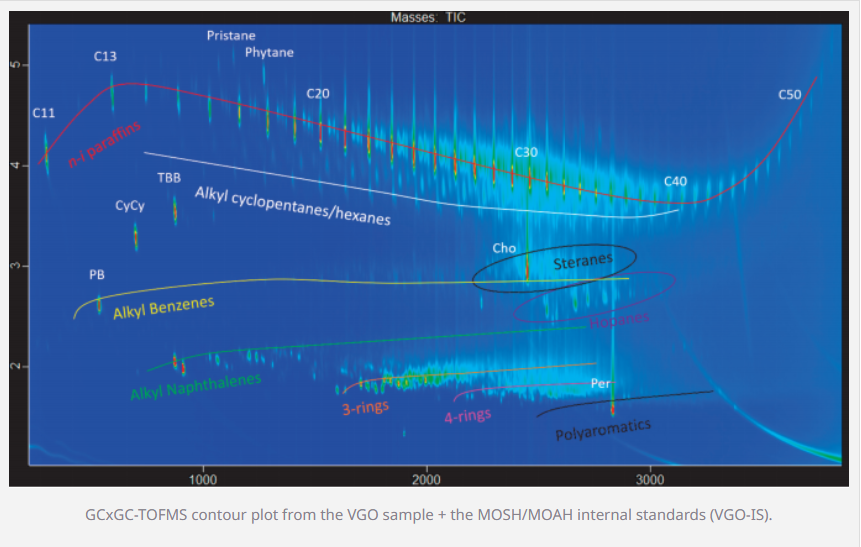
Some of these errors stem from the lack of a robust and reliable verification method. However, a GCxGC-TOFMS system like LECO’s Pegasus® BT 4D can help reveal the complexity of contaminated food samples. It has also been recommended by EFSA as a confirmatory tool when results from other standard methods are inconclusive. Part of the difficulties in determining MOSH and MOAH contamination in food samples stem from the difficulty of separating MOSH from POSH (Polyolefin Oligomeric Saturated Hydrocarbons) and/or MOAH from biogenic substances such as terpenoids. Similarities in reactions between these compounds can lead to erroneous results due to the inaccurate reporting of uncontaminated samples as contaminated. However, the exceptional resolution of Pegasus BT 4D allows for accurate identification and differentiation of these groups.